
Table of Contents
Introduction
Getting invited to a second job interview is an encouraging step in the hiring process. It usually means the employer wants to learn more about your qualifications, professional experience, and suitability for the position. second interview questions However, second interview questions are often more detailed and challenging than those asked during an initial interview.
Employers may explore your problem-solving abilities, teamwork, leadership skills, career goals, and approach to workplace challenges. Preparing thoughtful answers can help you communicate your strengths, build confidence, second interview questions and demonstrate how you can contribute to the organization.
This guide covers common second interview questions, sample answers, preparation strategies, and questions to ask employers during the next stage of recruitment.
What Is a Second Interview?
A second interview is a follow-up meeting conducted after a candidate successfully completes an initial interview or screening process.
While the first interview often focuses on basic qualifications, employment history, and general suitability, the second interview questions typically provides a deeper assessment of job-related skills and professional behavior.
Depending on the organization, you may meet with a hiring manager, department leader, potential colleagues, or senior executives.
Some second interviews also include practical assignments, technical assessments, presentations, or discussions about real workplace scenarios.
The purpose is to determine whether your experience, working style, and capabilities align with the position and the organization’s requirements.
Why Do Employers Conduct Second Interviews?
Employers use second interviews to gather additional information before making a hiring decision.
Evaluate Job-Specific Skills
Hiring managers may ask detailed questions about the responsibilities of the position. They want to understand how you apply your knowledge, solve problems, second interview questions and manage professional tasks.
Assess Teamwork and Communication
Second interviews often explore how candidates collaborate with colleagues, handle disagreements, and communicate with managers or clients.
Understand Career Goals
Employers may ask about your long-term ambitions to understand whether the role offers suitable opportunities for professional growth.
Compare Final Candidates
When several applicants meet the basic qualifications, a second interview can help employers compare their experience, judgment, and approaches to workplace situations.
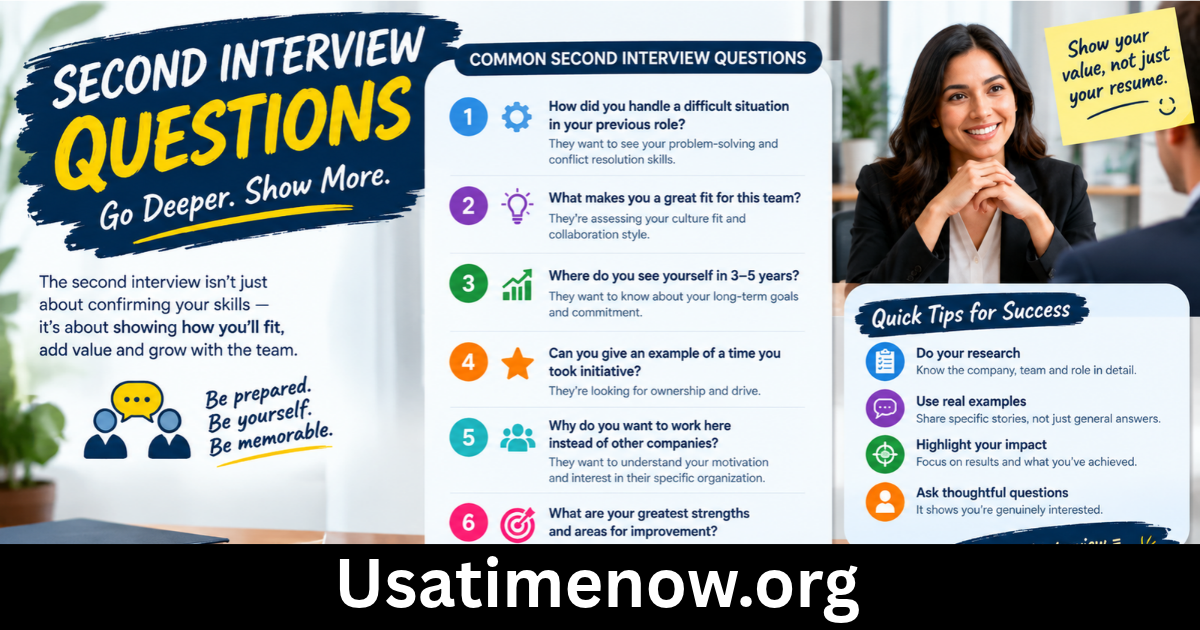
15 Common Second Interview Questions and Sample Answers
The following second-round interview questions are frequently used across different industries. Adapt the sample answers to reflect your actual experience and the requirements of the job.
1. Why Do You Want to Work for Our Company?
Employers ask this question to understand your motivation and whether you have researched the organization.
Sample answer:
“I am interested in your company because of its focus on innovation and professional development. After learning more about the position during my first interview, I believe my experience and skills align well with the team’s objectives. second interview questions I am excited about the opportunity to contribute while continuing to develop professionally.”
2. What Makes You the Best Candidate for This Position?
This question allows you to connect your qualifications with the employer’s needs.
Sample answer:
“My experience in managing projects, collaborating with teams, and meeting deadlines has prepared me for this role. I bring strong organizational skills, a practical approach to problem-solving, and a commitment to delivering high-quality work.”
Support your answer with a specific achievement whenever possible.
3. Tell Me About a Difficult Workplace Situation You Handled
Interviewers use behavioral questions to understand how you respond to challenges.
Sample answer:
“In a previous role, our team faced an unexpected project delay. I reviewed the remaining tasks, worked with colleagues to identify priorities, and helped develop a revised schedule. We completed the essential deliverables while maintaining clear communication with stakeholders.”
4. How Do You Prioritize Multiple Tasks?
This is an important second interview question for roles involving deadlines, coordination, or productivity management.
Sample answer:
“I prioritize tasks based on urgency, business impact, and deadlines. I use a task management system to track progress and divide larger assignments into manageable steps. second interview questions When priorities change, I communicate with relevant stakeholders and adjust my schedule.”
5. Describe a Time You Worked Successfully in a Team
Employers want to understand how you collaborate and contribute to shared goals.
Sample answer:
“During a major project, I worked with colleagues from different departments. We established clear responsibilities, scheduled regular updates, second interview questions and addressed challenges together. This approach improved coordination and helped us complete the project successfully.”
6. How Do You Handle Constructive Criticism?
Your answer should demonstrate openness to feedback and professional growth.
Sample answer:
“I view constructive criticism as an opportunity to improve. I listen carefully, ask questions when necessary, second interview questions and identify practical steps to address the feedback. I also follow up to make sure my improvements meet expectations.”
7. What Are Your Greatest Professional Strengths?
Choose strengths that directly relate to the job description.
Sample answer:
“My strongest skills are problem-solving, time management, and communication. I can organize complex assignments, identify practical solutions, and keep team members informed throughout a project.”
8. What Is Your Biggest Weakness?
Employers often ask this question to assess self-awareness and willingness to improve.
Sample answer:
“Earlier in my career, I sometimes spent too much time refining minor details. I have improved by setting clear priorities, defining quality standards, and using deadlines to maintain a balance between accuracy and efficiency.”
9. How Would You Handle a Disagreement With a Coworker?
This question assesses communication skills and conflict resolution.
Sample answer:
“I would discuss the issue privately and respectfully, listen to the other person’s perspective, and focus on finding a solution that supports our shared objectives. If necessary, I would involve a manager to help resolve the situation professionally.”
10. What Do You Know About Our Current Challenges?
Employers may ask this to evaluate your research and business awareness.
Sample answer:
“Based on my research and our previous discussion, I understand that your team is focused on improving operational efficiency. My experience with workflow improvements and project coordination could help support that objective.”
Avoid making assumptions about company challenges without supporting information.
11. Where Do You See Yourself in Five Years?
Hiring managers want to understand your professional direction and commitment to growth.
Sample answer:
“In five years, I hope to have developed deeper expertise in my field and taken on greater responsibilities. I would like to contribute to important projects, support team objectives, and continue learning skills that benefit the organization.”
12. How Do You Work Under Pressure?
This question helps employers evaluate your ability to remain productive during demanding situations.
Sample answer:
“When working under pressure, I focus on priorities, break complex tasks into smaller steps, and maintain communication with the team. I also monitor deadlines carefully so potential problems can be addressed early.”
13. Describe a Professional Achievement You Are Proud Of
Choose an accomplishment that demonstrates relevant skills and measurable results.
Sample answer:
“One achievement I am proud of was improving a reporting process that previously required several hours of manual work. I helped introduce a more organized workflow, which reduced repetitive tasks and allowed the team to focus on higher-value activities.”
Whenever possible, include accurate figures from your own experience.
14. What Are Your Salary Expectations?
This question may arise during a second interview when the employer is evaluating whether your expectations align with the available compensation range.
Sample answer:
“Based on the responsibilities of the role, my experience, and relevant market information, I am looking for a competitive salary within the appropriate range. I am also interested in understanding the complete compensation package, including benefits and growth opportunities.”
Research salary benchmarks before the interview and prepare a realistic range.
15. Do You Have Any Questions for Us?
This is an opportunity to demonstrate genuine interest in the position.
You could ask:
- What would success look like during the first 90 days?
- What are the team’s biggest priorities?
- How is employee performance evaluated?
- What professional development opportunities are available?
- What are the next steps in the hiring process?
Thoughtful questions help you evaluate the role while showing that you have considered its responsibilities.
How to Prepare for a Second Interview
Preparation is essential because second interviews often require more specific examples and deeper discussions.
Review Your First Interview
Think about the topics discussed during your initial interview. Identify questions that may require more detailed answers and review any information the employer shared about the role.
Research the Company Thoroughly
Explore the company’s website, products, services, values, and recent developments. Understanding its business model and priorities can help you explain how your skills may contribute to its goals.
Practice Behavioral Interview Questions
Behavioral questions frequently begin with phrases such as “Tell me about a time” or “Describe a situation.”
Use the STAR method to organize your answers:
- Situation: Explain the background.
- Task: Describe your responsibility.
- Action: Explain what you did.
- Result: Share the outcome.
This structure helps you provide clear and relevant examples.
Prepare Job-Specific Examples
Review the job description and identify the skills the employer considers most important.
Prepare examples showing how you have demonstrated those abilities through previous work, education, volunteering, or relevant projects.
Plan Your Interview Logistics
Confirm the interview date, time, format, and location. For virtual interviews, test your internet connection, microphone, and camera.
For in-person interviews, plan your travel and allow enough time to arrive punctually.
Second Interview Tips to Make a Strong Impression
During your second interview, maintain a professional attitude and communicate with confidence.
Listen carefully to each question and provide focused answers supported by relevant examples. Avoid memorizing responses word for word, as this can make your communication sound unnatural.
Show enthusiasm for the opportunity without exaggerating your abilities or making claims you cannot support.
You should also remain consistent with the information provided during your first interview. If your understanding of the role has changed, explain your updated perspective clearly.
After the interview, consider sending a brief thank-you email expressing appreciation for the interviewer’s time and reaffirming your interest in the position.
Common Second Interview Mistakes to Avoid
One common mistake is assuming that reaching the second interview guarantees a job offer. Employers may still be evaluating several qualified candidates.
Another mistake is repeating general answers from the first interview without adding new details. Second-round interviewers often expect specific achievements, practical examples, and thoughtful explanations.
Candidates should also avoid criticizing previous employers, exaggerating experience, or arriving without questions.
Finally, focusing only on salary and benefits can make it difficult to demonstrate interest in the responsibilities and long-term opportunities of the role.
Frequently Asked Questions About Second Interview Questions
1. Are second interview questions harder than first interview questions?
They are often more detailed and job-specific. Employers may ask behavioral, technical, or situational questions to better understand your abilities and working style.
2. How long does a second interview usually last?
A second interview may last approximately 30 to 90 minutes, although some employers schedule longer sessions involving multiple interviewers or assessments.
3. Does a second interview mean you will get the job?
No. It generally indicates that the employer is interested in learning more about you, but a hiring decision may still depend on additional evaluations and comparisons with other candidates.
4. What should I bring to a second interview?
For an in-person interview, consider bringing copies of your resume, a notebook, a pen, relevant work samples, and a list of questions. Bring any additional documents specifically requested by the employer.
5. How many questions should I ask in a second interview?
Preparing three to five thoughtful questions is usually a good approach. Prioritize questions about responsibilities, expectations, team collaboration, and professional development.
6. Should I discuss salary during a second interview?
Yes, if the employer raises the topic or the discussion naturally reaches compensation. Be prepared with a researched salary range and consider the overall benefits package.
7. What happens after a second interview?
The employer may conduct reference checks, schedule another interview, request an assessment, or make a hiring decision. The timeline varies depending on the organization and recruitment process.
Conclusion
Preparing for common second interview questions can help you communicate your qualifications, demonstrate professional strengths, second interview questions and approach the hiring process with greater confidence. Second interviews provide an opportunity to move beyond basic qualifications and show employers how you solve problems, collaborate with others, manage responsibilities, and contribute to workplace productivity.