






Table of Contents
Labor productivity is an important measure of economic performance that shows how efficiently workers produce goods and services. It helps businesses understand how effectively they use their workforce, time, and resources to achieve their goals. Higher labor productivity can support business growth, improve competitiveness, and contribute to better living standards.
In today’s competitive economy, organizations constantly look for ways to improve efficiency without compromising product quality or employee well-being. Understanding labor productivity allows employers, managers, policymakers, and workers to identify opportunities for improvement. By investing in skills, technology, effective management, and better working conditions, businesses can achieve stronger results and sustainable growth.
What Is Labor Productivity?
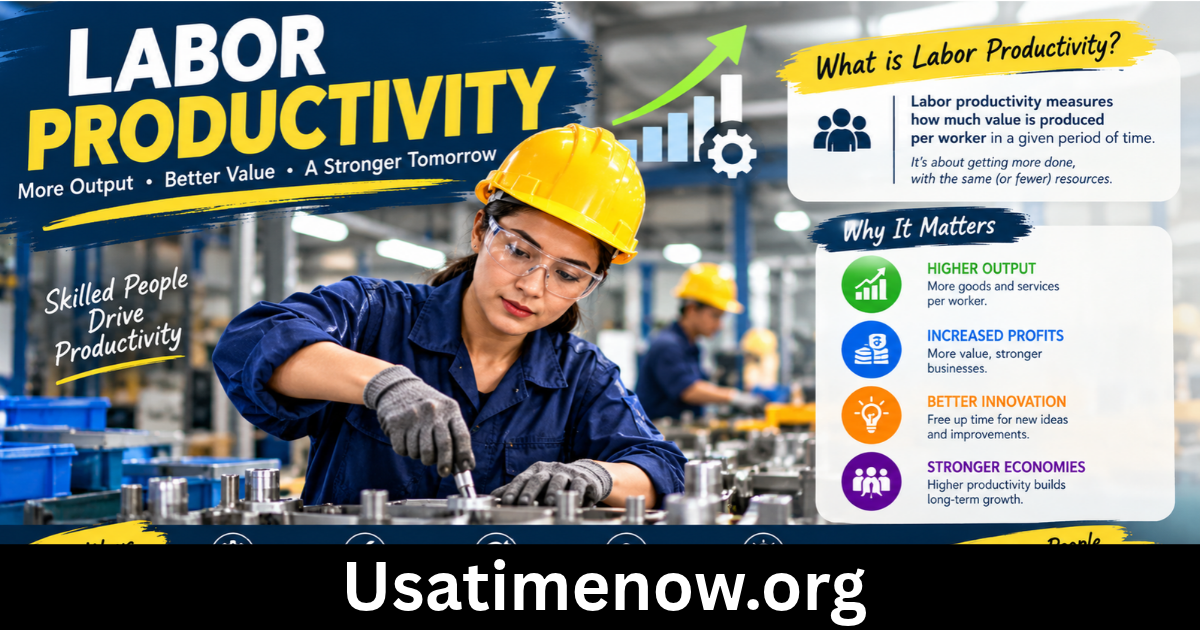
Labor productivity refers to the amount of goods or services produced for each unit of labor input. Labor input is commonly measured by the number of hours worked, although some organizations use the number of employees.
For example, if a factory produces 500 products in 100 working hours, its five products per labor hour. If the factory increases production to 600 products while using the same number of hours, productivity rises to six products per labor hour.
Labor productivity is not simply about making employees work faster. It also reflects improvements in equipment, processes, training, management, and the organization of work. The goal is to generate more valuable output from available labor resources.
How Is Labor Productivity Calculated?
Businesses and economists use different methods to calculate, depending on the information available and the type of output being measured.
The basic formula is:
Labor Productivity = Total Output ÷ Labor Input
For a business, output might represent products manufactured, services delivered, or revenue adjusted for relevant price changes. Labor input can be measured in hours worked or the number of workers.
For example, suppose a company generates 20,000 units of output over 2,000 labor hours.
Labor productivity = 20,000 ÷ 2,000 = 10 units per labor hour.
This result means the company produces an average of 10 units for every hour of labor used.
For economic analysis, labor productivity is often measured as real gross domestic product (GDP) per hour worked. Using real output helps account for changes in prices over time.
Why Is Labor Productivity Important?
1. Supports Economic Growth
Labor productivity is a major contributor to long-term economic growth. When workers can produce more value within the same amount of time, an economy can increase its output without requiring a proportional increase in working hours.
Higher productivity can help businesses expand, support innovation, and make more goods and services available to consumers. At the national level, sustained productivity growth can contribute to rising real incomes and improved living standards.
2. Improves Business Profitability
Efficient labor use can help businesses control operating costs and improve their financial performance. When employees have appropriate tools, clear instructions, and well-designed workflows, organizations may complete more work with fewer unnecessary delays.
However, productivity improvements do not automatically guarantee higher profits. Results also depend on demand, material costs, pricing, quality, and other business conditions.
3. Strengthens Competitiveness
Businesses with efficient production processes may be better positioned to offer competitive prices, deliver products on time, and maintain consistent quality.
Higher labor productivity can also free resources for research, customer service, and product development. These improvements can help organizations respond more effectively to changing customer needs and market conditions.
4. Creates Opportunities for Better Wages
When productivity increases sustainably, businesses may have greater capacity to invest in employees, raise compensation, or improve workplace benefits.
However, productivity gains do not automatically translate into higher wages. The distribution of those gains depends on factors such as labor market conditions, bargaining power, business strategy, and public policy.
Key Factors That Affect Labor Productivity
Employee Skills and Training
Workers with appropriate knowledge and practical skills can often complete tasks more accurately and efficiently. Regular training helps employees adapt to new technology, follow improved procedures, and solve workplace problems.
Professional development can also increase confidence and reduce errors, particularly in jobs that require technical expertise or specialized knowledge.
Technology and Equipment
Modern equipment, software, and automation can reduce repetitive work and improve production speed. Digital systems can also help organizations monitor performance, coordinate teams, and identify operational problems.
Nevertheless, technology is most effective when employees receive adequate training and systems are selected according to genuine business needs.
Management and Leadership
Effective management helps employees understand expectations, access necessary resources, and coordinate their responsibilities. Clear communication and realistic deadlines can reduce confusion and prevent duplicated work.
Managers who encourage feedback and recognize employee contributions may also help build stronger engagement and accountability.
Workplace Conditions
A safe, comfortable, and well-organized workplace can support concentration and reduce avoidable interruptions. Appropriate lighting, ergonomic equipment, reasonable workloads, and access to necessary tools can improve working conditions.
Excessive pressure, poor communication, and inadequate rest may have the opposite effect by increasing fatigue, errors, and employee turnover.
Employee Motivation and Engagement
Employees are more likely to perform effectively when they understand the purpose of their work and feel that their contributions matter.
Fair compensation, opportunities for development, constructive feedback, and recognition can support motivation. Organizations should also consider employee suggestions when improving workplace processes.
Practical Ways to Improve Labor Productivity
1. Set Clear Performance Goals
Establish measurable objectives that reflect the organization’s priorities. Goals might include reducing production delays, improving service quality, or completing orders within a defined period.
Targets should be realistic and should not encourage unsafe practices or lower-quality work.
2. Improve Workflow Efficiency
Review existing processes to identify unnecessary steps, repeated tasks, and common bottlenecks. Simplifying approval procedures and improving communication between departments can help work move more smoothly.
Small operational changes can produce meaningful improvements when they address recurring problems.
3. Invest in Employee Development
Provide training that helps workers strengthen relevant skills and use equipment effectively. Mentoring, workshops, and structured learning opportunities can support long-term performance.
Training should be evaluated by whether it improves practical skills, work quality, and the ability to complete tasks successfully.
4. Use Automation Where Appropriate
Automation can handle repetitive activities, reduce manual errors, and allow employees to concentrate on tasks requiring judgment or creativity.
Before introducing automated systems, businesses should assess implementation costs, maintenance requirements, training needs, and potential effects on jobs.
5. Monitor Results and Encourage Feedback
Track productivity indicators regularly, but interpret them in the context of quality, safety, and customer satisfaction. Output per labor hour may be useful in manufacturing, while service businesses may measure completed cases, response times, or other relevant outcomes.
Employee feedback can reveal problems that performance figures alone may not explain.
Labor Productivity vs. Labor Efficiency
Labor productivity and labor efficiency are related concepts, but they are not identical.
Labor productivity measures output relative to labor input. Labor efficiency often compares actual performance with a defined standard or expected level of resource use.
For example, a business may increase its output per labor hour while still using more hours than expected for each unit produced. In that case, productivity and efficiency measurements may provide different insights.
Using both measures can help managers understand how much work is completed and how effectively resources are used.
Frequently Asked Questions About Labor Productivity
1. What is a simple example of labor productivity?
If five workers produce 200 units during a combined 40 labor hours, labor productivity is five units per labor hour. This calculation shows the average output produced for each hour of labor.
2. What is the formula for labor productivity?
The basic formula is total output divided by labor input. Labor input may be measured in hours worked or the number of employees, depending on the purpose of the calculation.
3. Why is labor productivity important to businesses?
It helps businesses evaluate performance, identify operational problems, manage labor costs, and make informed decisions about training, equipment, and workflow improvements.
4. What causes low labor productivity?
Common causes include outdated equipment, insufficient training, unclear instructions, poor management, inefficient processes, workplace distractions, and inadequate staffing.
5. How can employees improve their productivity?
Employees can improve productivity by developing relevant skills, organizing tasks, communicating effectively, using available tools properly, and identifying practical ways to reduce unnecessary work.
6. Does higher labor productivity always mean fewer workers are needed?
No. Higher productivity may allow a business to produce more with its existing workforce, but it can also support expansion and create demand for additional employees. The outcome depends on market demand, technology, and business strategy.
7. How does labor productivity affect wages?
Productivity growth can create opportunities for higher real wages by increasing the value produced per hour. However, wage outcomes also depend on economic conditions, labor institutions, and how productivity gains are distributed.
Conclusion
Labor productivity is a valuable indicator of how efficiently workers produce goods and services. It influences business performance, economic growth, competitiveness, and the potential for improving living standards. Organizations can improve labor productivity by investing in employee training, adopting suitable technology, simplifying workflows, strengthening management, and creating supportive working conditions. Measuring output alongside quality, safety, and employee well-being provides a more complete picture of performance.