






Table of Contents
Introduction
A 9 box talent review is a popular talent management tool that helps organizations evaluate employee performance and future potential. By placing employees into a nine-cell grid, managers can identify high performers, emerging leaders, employees who need additional support, 9 box talent review and individuals who may benefit from new development opportunities. This structured approach makes it easier to plan leadership succession, improve workforce productivity, and make informed decisions about employee growth.
For businesses focused on productivity and long-term success, the 9 box talent review provides a clear framework for understanding workforce capabilities and preparing employees for future responsibilities.
What Is a 9 Box Talent Review?
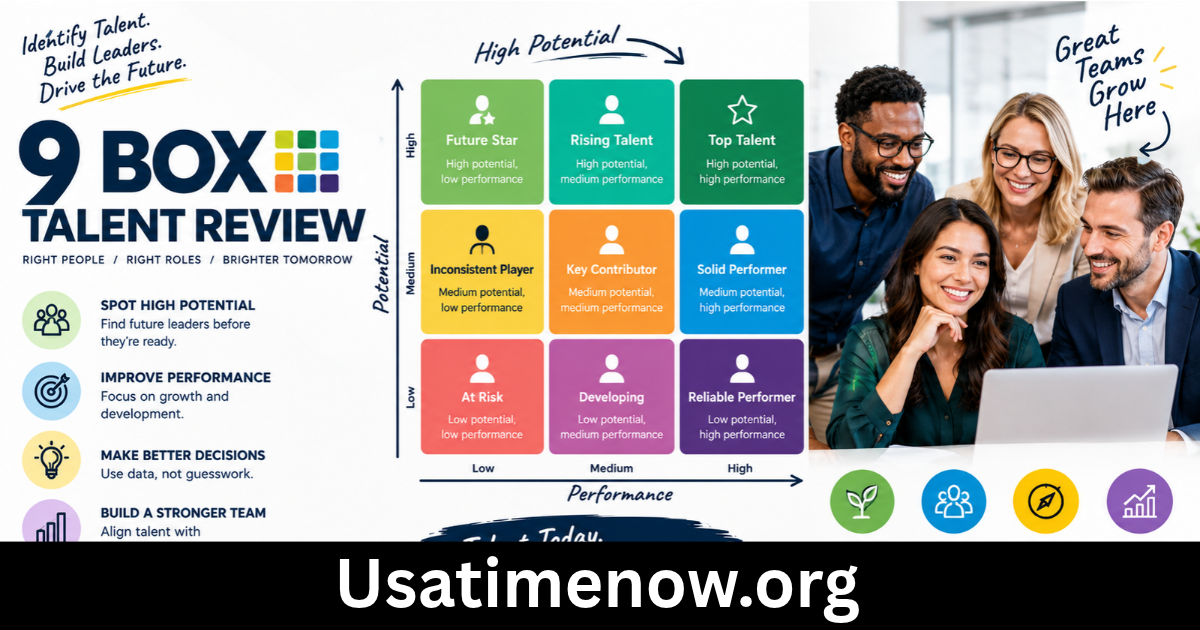
The 9 box talent review, also known as the nine-box grid, is a performance and potential assessment framework used by human resources teams and business leaders. It evaluates employees across two main dimensions: current job performance and future leadership potential.
Performance measures how effectively an employee meets current responsibilities, achieves goals, and contributes to business results. Potential estimates an employee’s capacity to take on more complex work, develop new skills, or succeed in a larger role.
Each dimension typically has three levels: low, moderate, and high. Combining these levels creates nine possible employee categories. The grid helps managers discuss talent consistently rather than relying only on personal impressions or recent achievements.
Understanding the Nine Boxes
The nine-box grid combines three performance levels with three potential levels. Although organizations may use different labels, the categories commonly fall into the following groups.
1. High Performance and High Potential
Employees in this category consistently deliver strong results and demonstrate the ability to grow into more complex roles. They may be suitable candidates for leadership development, succession planning, stretch assignments, or broader responsibilities.
However, high performance does not automatically guarantee leadership success. Managers should also consider communication, judgment, collaboration, and the employee’s interest in career advancement.
2. High Performance and Moderate Potential
These employees perform exceptionally well in their current roles but may have a more gradual development path toward broader responsibilities. They can be valuable specialists, experienced team members, or future leaders with the right support.
Organizations can retain and motivate these employees through recognition, advanced training, and opportunities to deepen their expertise.
3. High Performance and Low Potential
This category can describe employees who excel in their current positions but are not currently expected to move into substantially broader roles. It should not be interpreted as a judgment of personal worth or a permanent limit on growth.
Managers can focus on career satisfaction, specialist development, mentoring, and retaining the knowledge these employees contribute.
4. Moderate Performance and High Potential
Employees in this group may demonstrate strong learning ability, adaptability, and leadership qualities, even if their current performance is not yet consistently high. They may need clearer goals, more experience, coaching, or better alignment between their skills and responsibilities.
A targeted development plan can help them translate their potential into measurable results.
5. Moderate Performance and Moderate Potential
These employees generally meet expectations and show opportunities for continued improvement. Their development may involve strengthening core skills, increasing accountability, and improving consistency.
Regular feedback and realistic goals can help managers determine whether employees are ready for additional responsibilities over time.
6. Moderate Performance and Low Potential
Employees in this category may be most effective when responsibilities are clearly defined and support is readily available. Managers can identify skill gaps, clarify expectations, and provide practical training.
The objective should be to improve performance and role fit rather than make assumptions about an employee’s future based on a single review.
7. Low Performance and High Potential
This category includes employees who appear capable of growth but are not currently achieving expected results. Possible causes include insufficient training, unclear priorities, poor role fit, limited resources, or personal circumstances affecting work.
Managers should investigate the reasons behind performance gaps before deciding on development actions. Coaching, revised goals, or a role adjustment may help improve results.
8. Low Performance and Moderate Potential
Employees in this group may need structured support to meet role expectations. Managers should establish specific performance goals, provide timely feedback, and arrange training where appropriate.
Progress should be reviewed regularly so that employees understand what improvement looks like and how success will be measured.
9. Low Performance and Low Potential
Employees in this category may require a thorough review of their role, performance history, and support needs. Managers should confirm that expectations are reasonable and that employees have received appropriate resources and feedback.
Depending on the circumstances, suitable actions may include additional training, role redesign, reassignment, or a formal performance improvement process.
How to Conduct a 9 Box Talent Review
An effective 9 box talent review requires preparation, consistent criteria, and constructive follow-up. The following steps can help organizations conduct a more reliable assessment.
Step 1: Define Performance and Potential Criteria
Before evaluating employees, establish what high, moderate, and low performance mean within the organization. Use measurable indicators such as goal achievement, quality of work, reliability, and relevant role-specific outcomes.
Potential criteria may include learning agility, problem-solving, adaptability, collaboration, and readiness to handle greater complexity. Potential should be assessed against a defined role or career path, not vague ideas about leadership.
Step 2: Gather Reliable Employee Data
Collect information from performance reviews, goal-tracking systems, project outcomes, skills assessments, and manager feedback. Where appropriate, include input from multiple colleagues to develop a broader understanding of an employee’s contribution.
Using evidence from a meaningful period reduces the risk of overvaluing one recent success or mistake.
Step 3: Hold a Talent Calibration Meeting
Managers and HR professionals should discuss assessments together to identify inconsistent ratings and challenge unsupported assumptions. Calibration meetings help ensure that employees are evaluated against comparable standards.
These discussions should focus on observable evidence, role requirements, and development opportunities rather than personality preferences or workplace relationships.
Step 4: Place Employees on the Grid
Once the criteria and evidence have been reviewed, assign employees to the appropriate cells. The grid should summarize the discussion, not replace professional judgment.
Organizations should also document the reasoning behind placements so future reviews can assess progress and explain changes.
Step 5: Create Individual Development Plans
Every assessment should lead to meaningful action. Development plans may include mentoring, training, leadership projects, job shadowing, cross-functional assignments, or improved performance goals.
Set clear milestones and review dates so employees and managers can track progress over time.
Benefits of the 9 Box Talent Review
Better Succession Planning
The nine-box grid helps organizations identify potential successors for important positions. By recognizing development needs early, businesses can prepare employees for future vacancies and reduce disruption when experienced leaders leave.
Improved Employee Development
The framework makes it easier to match development opportunities with individual needs. High-potential employees may receive stretch assignments, while employees experiencing performance challenges may receive focused coaching.
More Informed Workforce Decisions
Talent reviews give HR teams a structured way to discuss workforce strengths, skill gaps, and future staffing requirements. When supported by reliable data, these discussions can improve talent planning and resource allocation.
Stronger Productivity and Retention
Employees are more likely to develop when expectations are clear and opportunities match their capabilities. Recognition, useful feedback, and relevant training can support engagement and improve productivity.
However, the grid alone does not guarantee better retention or performance. Results depend on the quality of management decisions and the follow-through after each review.
Common Mistakes to Avoid
One common mistake is treating the 9 box talent review as a permanent label. Employee performance and potential can change as people gain experience, receive support, or move into different roles.
Another mistake is confusing current performance with future potential. An excellent specialist may not want to become a manager, while an employee who is still developing may demonstrate strong capacity for future growth.
Organizations should also avoid unconscious bias, unclear criteria, and decisions based on limited evidence. Ratings should be reviewed for consistency and fairness, and employees should receive appropriate feedback about their development.
Finally, companies should protect confidential employee information and avoid using the grid as the sole basis for promotions, compensation, termination, or other consequential employment decisions.
Best Practices for an Effective Talent Review
To get the most value from the nine-box grid, organizations should review employees regularly and update assessments when meaningful new evidence becomes available. Annual reviews may be supplemented by quarterly development discussions, depending on business needs.
Managers should communicate expectations clearly, provide constructive feedback, and give employees access to realistic growth opportunities. HR teams can monitor outcomes across departments to identify inconsistent ratings or potential bias.
The process should also connect with broader workforce planning. When talent reviews inform training budgets, succession plans, and skills development, the grid becomes more useful than a standalone chart.
Frequently Asked Questions
1. What is the main purpose of a 9 box talent review?
Its main purpose is to evaluate employee performance and potential in a consistent framework. Organizations use the results to guide employee development, succession planning, coaching, and workforce decisions.
2. What are the two dimensions of the nine-box grid?
The two dimensions are current job performance and future potential. Each dimension typically has three levels: low, moderate, and high.
3. Who should participate in a 9 box talent review?
The process usually involves managers, HR professionals, and relevant senior leaders. Multiple perspectives can improve consistency when participants use clear criteria and evidence-based assessments.
4. How often should companies conduct talent reviews?
Many organizations conduct formal talent reviews annually, with additional check-ins throughout the year. The ideal schedule depends on business needs, workforce changes, and the frequency of performance discussions.
5. Is the 9 box talent review only for leadership positions?
No. Although it is widely used for leadership succession, the framework can support development and workforce planning for employees across different functions. Criteria should be adapted to the role and career path being evaluated.
6. Can an employee move between boxes?
Yes. Employees can move between categories as their performance, skills, experience, responsibilities, and development needs change. The grid should reflect current evidence rather than serve as a permanent classification.
7. What is the biggest limitation of the nine-box grid?
The grid simplifies complex employee capabilities into nine categories. It can also reflect bias if criteria are vague or assessments rely on personal opinions. It works best when combined with documented evidence, constructive conversations, and ongoing development plans.
Conclusion
The 9 box talent review is a practical framework for evaluating employee performance and future potential. By organizing talent into nine categories, businesses can identify strengths, address performance gaps, develop future leaders, and support succession planning. Its effectiveness depends on fair criteria, reliable evidence, regular calibration, 9 box talent review and meaningful follow-up. Rather than using the grid to label employees, organizations should treat it as a starting point for better conversations and targeted development. When integrated into a broader talent management strategy, the nine-box grid can help build a more capable, productive, and adaptable workforce.