






Table of Contents
Understanding the NPS score meaning is important for businesses that want to measure customer satisfaction, loyalty, and the likelihood that customers will recommend their products or services. nps score meaning, a widely used metric that helps organizations understand how customers feel about their overall experience.
Businesses use NPS surveys to identify strengths, discover customer concerns, and improve their products, services, and customer support. nps score meaning However, knowing the score alone is not enough. Companies must also understand how NPS is calculated, what the results indicate, and how to use customer feedback to make meaningful improvements.
What Is the Meaning of NPS Score?
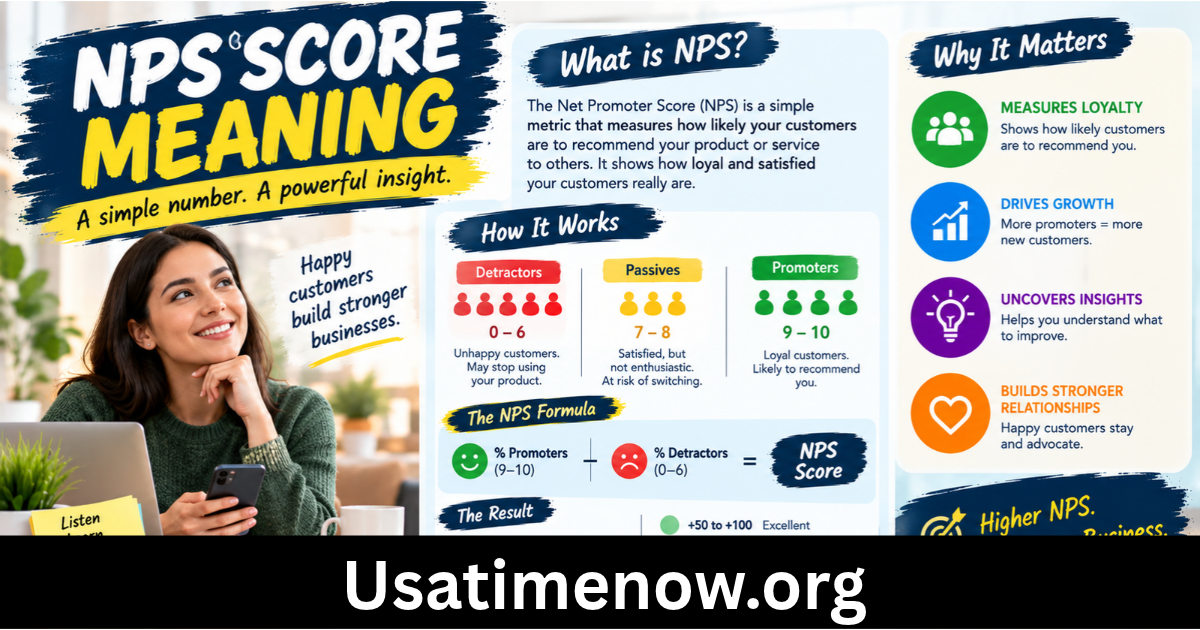
NPS stands for Net Promoter Score. It is a customer experience metric that measures how likely customers are to recommend a company, product, or service to others.
The standard NPS question is usually phrased as:
“How likely are you to recommend this company, product, or service to a friend or colleague?”
Customers answer on a scale from 0 to 10, where 0 means they are not at all likely to recommend the business and 10 means they are extremely likely to recommend it.
Based on their answers, respondents are divided into three categories: Promoters, Passives, and Detractors. nps score meaning These categories help businesses understand customer loyalty and identify areas where the customer experience may need improvement.
How Is NPS Calculated?
The Net Promoter Score calculation is straightforward. First, classify survey respondents according to their ratings. Then calculate the percentage of Promoters and the percentage of Detractors.
The formula is:
NPS = Percentage of Promoters − Percentage of Detractors
The final score ranges from -100 to +100.
Passives are included in the total number of survey respondents when calculating percentages, but their percentage is not directly added to or subtracted from the NPS score.
Example of an NPS Calculation
Imagine a business receives 100 customer responses:
- 60 customers give a score of 9 or 10.
- 25 customers give a score of 7 or 8.
- 15 customers give a score between 0 and 6.
In this example:
- Promoters: 60%
- Passives: 25%
- Detractors: 15%
The NPS calculation is:
60 − 15 = 45
The business has an NPS of +45.
This score indicates that the percentage of Promoters exceeds the percentage of Detractors by 45 percentage points. nps score meaning It does not mean that 45% of customers are Promoters or that 45% of customers are completely satisfied.
Understanding Promoters, Passives, and Detractors
The three NPS categories provide useful context for interpreting customer responses.
Promoters: Scores of 9–10
Promoters are customers who give ratings of 9 or 10. They are generally considered the most enthusiastic group and may be more likely to recommend a company, make repeat purchases, or share positive experiences.
Businesses can learn from Promoters by identifying which products, services, or interactions contributed to their positive feedback.
Passives: Scores of 7–8
Passives give ratings of 7 or 8. They are generally satisfied but may not be enthusiastic enough to actively recommend the business.
Although Passives do not directly affect the NPS calculation, their feedback can reveal opportunities to improve convenience, product quality, customer support, or overall value.
Detractors: Scores of 0–6
Detractors give ratings between 0 and 6. These customers may have experienced problems or feel that a product or service did not meet their expectations.
Their responses can help businesses identify recurring complaints, confusing processes, service delays, or quality issues. nps score meaning Following up respectfully can help organizations understand the underlying causes of negative experiences.
What Is a Good NPS Score?
A good NPS score depends on the industry, customer group, survey method, and business model. A score that is strong in one sector may be less impressive in another.
As a general interpretation:
- Below 0: More Detractors than Promoters.
- 0 to 30: A positive score, although improvement opportunities may remain.
- 31 to 50: Often considered a strong result.
- 51 to 70: A very strong score in many contexts.
- Above 70: An exceptionally high score in many settings.
These ranges are informal guidelines, not universal standards. They should not replace reliable industry benchmarks or comparisons with a company’s own historical results.
A business should also consider the response rate, number of respondents, customer demographics, and survey timing before drawing conclusions. nps score meaning A high NPS from a small or unrepresentative group may not accurately reflect the entire customer base.
Why Is NPS Important for Businesses?
Net Promoter Score can help companies understand customer perceptions and prioritize improvements.
1. Measures Customer Loyalty
NPS provides a simple way to track how willing customers are to recommend a business. Repeated surveys can show whether customer perceptions are improving or declining over time.
2. Identifies Customer Experience Problems
A low score or a growing number of Detractors can signal issues that deserve investigation. Written feedback can help explain whether the problem involves pricing, delivery, product quality, communication, nps score meaning or customer support.
3. Supports Better Business Decisions
When combined with other customer data, NPS can help businesses decide which areas need attention. For example, a company may investigate whether negative ratings are associated with a particular product, service channel, or stage of the customer journey.
4. Encourages Customer-Centered Improvements
Sharing survey findings with relevant teams can help employees understand customer expectations. Businesses can use the information to refine processes, improve training, and make service interactions more effective.
5. Tracks Changes Over Time
Consistent surveys can help companies monitor the effects of changes to products, pricing, policies, or support services. nps score meaning Tracking trends is often more useful than focusing on a single score.
NPS vs. Customer Satisfaction Score (CSAT)
NPS and Customer Satisfaction Score, commonly known as CSAT, measure related but different aspects of the customer experience.
NPS focuses on a customer’s willingness to recommend a company, product, or service.
CSAT measures how satisfied a customer is with a particular interaction, purchase, or experience.
For example, a customer might be satisfied with a recent support conversation but still be unlikely to recommend the company overall. Another customer might recommend a brand even after experiencing a minor issue.
Businesses can use both metrics to develop a more complete understanding of customer experience. NPS offers a broader recommendation-focused perspective, nps score meaning while CSAT helps assess satisfaction with specific interactions.
How to Improve Your NPS Score
Improving NPS requires understanding why customers give particular ratings and addressing the problems behind their feedback.
Listen to Customer Feedback
Include an optional follow-up question asking customers why they selected their rating. Open-ended responses can provide context that a numerical score cannot capture on its own.
Resolve Recurring Problems
Look for patterns in complaints and negative comments. Common issues such as delayed deliveries, confusing billing, poor communication, or difficult cancellation processes may deserve priority.
Improve Customer Support
Make it easier for customers to get accurate answers and resolve problems. Clear communication, knowledgeable support staff, nps score meaning and reasonable response times can contribute to better experiences.
Close the Feedback Loop
Where appropriate, follow up with customers who report problems. Acknowledge their concerns, explain what can be done, and use recurring feedback to inform wider improvements.
Measure Progress Consistently
Use a consistent survey question, rating scale, and sampling approach when tracking NPS over time. Changes in survey methods or respondent groups can make comparisons less reliable.
Businesses should avoid pressuring customers to provide high ratings. Honest feedback is more useful than artificially inflated scores.
Common Limitations of NPS
Although NPS is easy to understand, it does not explain every aspect of customer loyalty or business performance.
First, a single rating cannot fully describe why a customer feels a certain way. Second, survey results may be affected by response bias, because people who choose to respond may differ from those who do not. Third, the score does not directly measure revenue, retention, or actual recommendations.
For these reasons, businesses should combine NPS with written feedback, customer retention data, complaints, CSAT, and other relevant measures. NPS is most valuable when it supports investigation and action rather than being treated as a complete picture of customer loyalty.
Frequently Asked Questions About NPS Score Meaning
1. What does NPS score mean?
NPS score means Net Promoter Score. It measures how likely customers are to recommend a company, product, or service based on a survey rating from 0 to 10.
2. What is a good NPS score?
A positive NPS is generally preferable to a negative one, but what counts as good depends on the industry, survey method, and customer group. Industry benchmarks and historical results provide better context than a universal target.
3. Can NPS be negative?
Yes. NPS ranges from -100 to +100. A negative score means that the percentage of Detractors is greater than the percentage of Promoters.
4. Are Passives included in the NPS calculation?
Yes. Passives are included in the total number of respondents used to calculate the percentages. However, their percentage is neither added to nor subtracted from the final NPS score.
5. What is the difference between NPS and CSAT?
NPS measures willingness to recommend a business, while CSAT measures satisfaction with a product, service, or specific interaction. Using both can provide a broader understanding of customer experience.
6. How often should a business measure NPS?
The ideal frequency depends on the business and customer journey. Some companies survey customers after important interactions, while others conduct periodic relationship surveys. Consistency and avoiding excessive survey requests are important.
7. Does a high NPS guarantee business growth?
No. A high NPS can indicate positive customer perceptions, but it does not guarantee higher revenue, retention, or profitability. Businesses should compare NPS with actual customer behavior and other performance indicators.
Conclusion
Understanding the NPS score meaning helps businesses evaluate how willing customers are to recommend their products or services. By classifying responses as Promoters, Passives, and Detractors, companies can calculate a score between -100 and +100 and identify patterns in customer sentiment. nps score meaning However, NPS is most useful when combined with customer comments, industry context, and other performance measures. Businesses that listen to feedback, address recurring problems, and track results consistently can use Net Promoter Score as one practical tool for improving customer experiences and building stronger relationships.