






Table of Contents
Understanding how much money you will receive after taxes and deductions is an important part of managing your finances. paycheck estimator A paycheck estimator helps employees calculate their expected take-home pay based on their salary or hourly wages, tax withholdings, and other deductions. It can also help job seekers compare employment offers and plan their monthly budgets.
Whether you earn an hourly wage or an annual salary, knowing how to estimate your paycheck makes it easier to understand your income. This guide explains how a paycheck estimator works, what information you need, how to calculate net pay, and how to use your results for better financial planning.
What Is a Paycheck Estimator?
A paycheck estimator is a financial calculator that helps individuals estimate how much they will receive in each paycheck after applicable taxes and deductions.
It typically uses information such as:
- Annual salary or hourly wage
- Hours worked per week
- Pay frequency
- Federal, state, or local tax information, where applicable
- Retirement contributions
- Health insurance premiums
- Other payroll deductions
The calculator uses these details to estimate gross income, deductions, and net pay.
A paycheck estimator provides an approximation rather than an official payroll calculation. Actual take-home pay depends on current tax rules, employer policies, benefits, and individual circumstances.
What Is the Difference Between Gross Pay and Net Pay?
Understanding gross pay and net pay is essential when estimating your paycheck.
Gross Pay
Gross pay is the total amount an employee earns before taxes and other deductions are removed. It may include regular wages, salary, overtime, bonuses, commissions, and certain allowances.
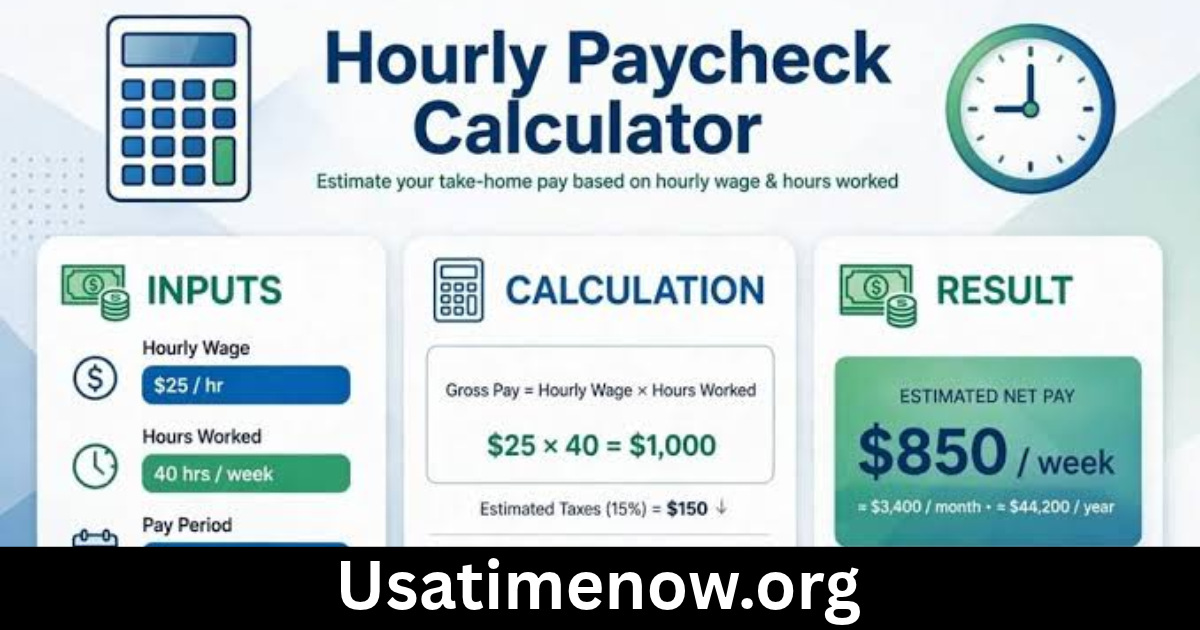
For example, an employee earning $25 per hour and working 40 hours per week has weekly gross pay of $1,000 before deductions.
Net Pay
Net pay is the amount an employee receives after applicable taxes and deductions have been subtracted. It is commonly called take-home pay.
Basic formula:
Net Pay = Gross Pay − Taxes − Other Deductions
For example, if your gross paycheck is $2,000 and total deductions are $450, your estimated net paycheck is $1,550.
How Does a Paycheck Estimator Work?
A paycheck estimator uses your earnings and deduction information to calculate an approximate payment amount.
1. Enter Your Income
Start by entering your annual salary or hourly wage. If you are paid hourly, include the number of hours you usually work each week.
For employees who receive bonuses, commissions, or overtime, additional earnings may also affect the calculation.
2. Select Your Pay Frequency
Your pay frequency determines how often you receive compensation. Common payroll schedules include:
- Weekly: 52 paychecks per year
- Biweekly: 26 paychecks per year
- Semimonthly: 24 paychecks per year
- Monthly: 12 paychecks per year
These figures assume a standard calendar year and may vary slightly in unusual payroll arrangements.
3. Enter Tax Information
If you are using a U.S.-based paycheck estimator, you may need to provide information about federal income tax withholding, state taxes, local taxes, and Social Security and Medicare taxes.
Your filing status and withholding information can affect the estimated result.
Tax systems differ by country, so users outside the United States should choose a calculator designed for their local tax rules.
4. Include Other Deductions
Add regular payroll deductions, such as health insurance premiums, retirement contributions, or other authorized deductions.
Pre-tax and post-tax deductions may be treated differently when calculating taxable income.
5. Review Your Estimated Take-Home Pay
After entering the required information, the estimator calculates your approximate net paycheck. Many calculators also show annual, monthly, biweekly, or weekly income estimates.
How to Calculate Your Paycheck Manually
You do not always need an online calculator to estimate your earnings. You can use a few basic formulas to understand your expected paycheck.
Calculate Annual Gross Income
For hourly employees:
Annual Gross Income = Hourly Rate × Hours per Week × 52
For example, an employee earning $20 per hour and working 40 hours per week has estimated annual gross income of:
$20 × 40 × 52 = $41,600
For salaried employees, annual gross income is generally the agreed annual salary before deductions.
Calculate Gross Pay Per Pay Period
Divide your annual salary by the number of pay periods in a year.
For example, an employee earning $60,000 annually and receiving biweekly payments has:
$60,000 ÷ 26 = $2,307.69 gross pay per paycheck
Estimate Net Pay
Subtract estimated taxes and other deductions from gross pay.
For example:
| Paycheck Details | Amount |
|---|---|
| Gross biweekly pay | $2,307.69 |
| Estimated taxes | $350.00 |
| Retirement contribution | $100.00 |
| Insurance premium | $75.00 |
| Estimated net pay | $1,782.69 |
<text>These figures are illustrative only. Actual deductions depend on the employee’s location, tax situation, and benefit elections.</text>
Factors That Affect Your Take-Home Pay
Several factors influence how much money appears in your paycheck.
1. Annual Salary or Hourly Wage
Your base compensation is the starting point for paycheck calculations. Higher gross earnings generally result in higher take-home pay, although taxes and other deductions may also increase.
2. Pay Frequency
Pay frequency changes the amount received in each paycheck, but it does not necessarily change total annual earnings.
For example, an employee earning $52,000 annually would generally receive $1,000 gross per week or $2,000 gross every two weeks, assuming 52 weeks and 26 biweekly periods.
3. Tax Withholding
Income tax withholding depends on applicable tax laws and personal tax information. In the United States, federal, state, and local income taxes may affect take-home pay.
4. Retirement Contributions
Contributions to retirement plans can reduce the amount deposited into your bank account. Some contributions may receive favorable tax treatment, depending on the plan and applicable rules.
5. Health Insurance and Benefits
Health insurance premiums, dental coverage, vision plans, and other employee benefits may be deducted from payroll.
6. Overtime and Bonuses
Overtime, commissions, and bonuses can increase gross earnings. However, additional earnings may also affect withholding calculations and the final paycheck amount.
Benefits of Using a Paycheck Estimator
A paycheck estimator can be useful for employees, job seekers, and individuals planning their household finances.
Better budgeting: Estimating your net income helps you plan rent, groceries, transportation, savings, and other expenses.
Comparing job offers: You can compare estimated take-home pay from different salary offers rather than focusing only on annual gross compensation.
Understanding deductions: A paycheck calculator can help explain how taxes, insurance, and retirement contributions affect your income.
Planning salary negotiations: Knowing your estimated take-home pay can help you evaluate whether a proposed salary meets your financial needs.
Preparing for changes: You can estimate how a raise, additional working hours, or a change in benefits might affect your paycheck.
Common Mistakes to Avoid When Estimating Your Paycheck
Paycheck estimates are only useful when the information entered is accurate. Avoid these common mistakes:
- Entering annual salary instead of hourly pay, or vice versa.
- Selecting the wrong pay frequency.
- Forgetting to include overtime or additional earnings.
- Leaving out insurance premiums or retirement contributions.
- Using outdated tax rates or withholding information.
- Assuming an estimated paycheck will exactly match your actual payment.
For the most reliable estimate, use current tax information and review your employer’s payroll and benefits details.
7 Frequently Asked Questions About Paycheck Estimators
1. What Does a Paycheck Estimator Calculate?
A paycheck estimator calculates approximate take-home pay by considering gross earnings, taxes, and other payroll deductions. It may also provide estimated weekly, biweekly, monthly, and annual income.
2. Is a Paycheck Estimator Accurate?
A paycheck estimator can provide a useful approximation when the information entered is correct. However, actual payroll results may differ because of tax rules, employer deductions, benefits, and individual circumstances.
3. How Do I Calculate My Take-Home Pay?
Start with your gross earnings, subtract applicable taxes and payroll deductions, and the remaining amount is your estimated net pay.
4. How Much Is a $60,000 Salary Per Paycheck?
A $60,000 annual salary equals approximately $2,307.69 gross every two weeks, assuming 26 pay periods. Your actual take-home pay will be lower after taxes and deductions.
5. Does Pay Frequency Affect My Total Annual Salary?
No. Weekly, biweekly, semimonthly, and monthly schedules divide your annual compensation into different payment amounts. They generally do not change the agreed annual salary.
6. Can I Use a Paycheck Estimator for Hourly Jobs?
Yes. Enter your hourly wage, expected working hours, overtime if applicable, and pay frequency. The estimator can use this information to calculate your approximate gross and net earnings.
7. What Is the Difference Between a Paycheck Estimator and a Tax Calculator?
A paycheck estimator focuses on expected take-home pay after payroll taxes and deductions. A tax calculator generally focuses on estimating tax liability. Some tools combine both functions.
Conclusion
A paycheck estimator is a helpful tool for understanding your expected take-home pay and making informed financial decisions. paycheck estimator By entering your salary or hourly wage, selecting your pay frequency, and including relevant taxes and deductions, you can estimate how much money you may receive. Although an estimator cannot replace an official payroll statement, it can help you create a realistic budget, compare job offers, and understand the impact of benefits and deductions. For the best results, use current tax information and a calculator designed for your country or region.