







Table of Contents
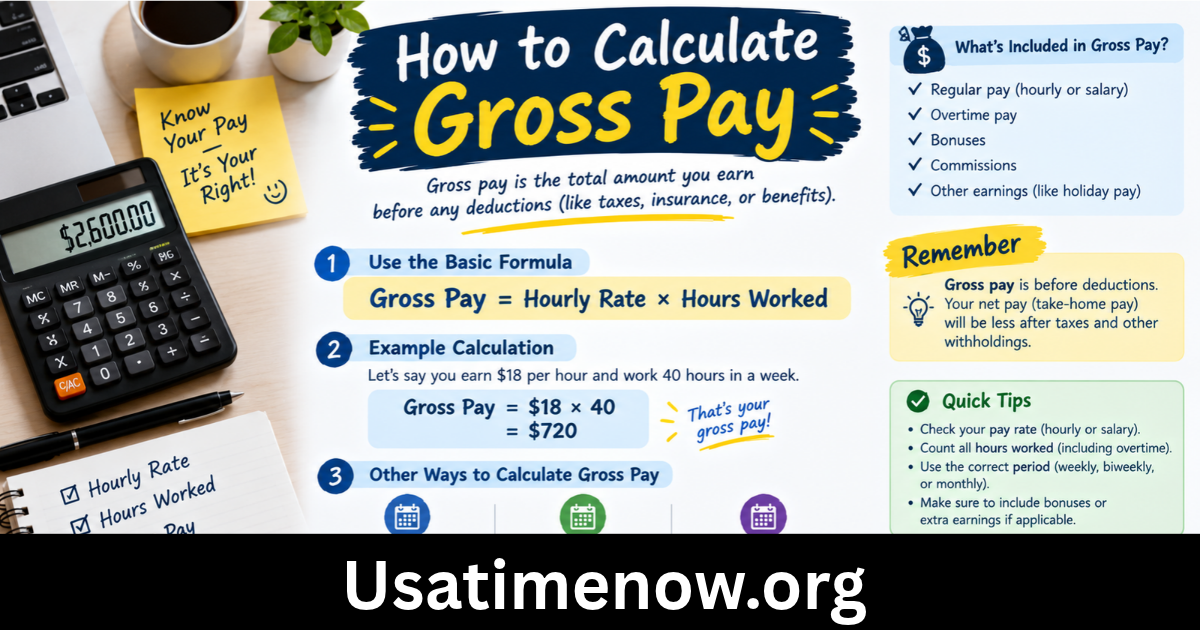
Understanding how to calculate gross pay is essential for employees, employers, payroll professionals, and anyone managing a personal budget. how to calculate gross pay Gross pay is the total amount an employee earns before deductions such as taxes, insurance premiums, and retirement contributions are taken out. Knowing how to calculate it helps you understand your earnings, check your paycheck, and plan your finances more accurately.
The calculation depends on how you are paid, including whether you receive an hourly wage, a fixed salary, overtime pay, bonuses, or commissions. This guide explains how to calculate gross pay using simple formulas and practical examples.
What Is Gross Pay?
Gross pay is the total compensation an employee earns during a specific pay period before any deductions are subtracted. It may include regular wages, salary, overtime, bonuses, commissions, and other eligible forms of compensation.
For example, if an employee earns $1,000 in regular wages and $150 in overtime during a pay period, their gross pay is $1,150 before deductions.
Gross pay is different from net pay. Net pay is the amount an employee actually receives after taxes and other applicable deductions have been taken out.
How to Calculate Gross Pay
The basic gross pay formula is:
Gross Pay = Regular Earnings + Overtime Pay + Additional Earnings
Additional earnings may include bonuses, commissions, shift differentials, or other compensation, depending on the employee’s agreement and payroll rules.
The exact calculation depends on the employee’s pay structure.
How to Calculate Gross Pay for Hourly Employees
Hourly employees earn money based on the number of hours they work and their hourly wage.
The basic formula is:
Gross Pay = Hours Worked × Hourly Rate
Example of Hourly Gross Pay
Suppose an employee earns $20 per hour and works 40 hours during one week.
- Hourly rate: $20
- Hours worked: 40
- Gross pay: 40 × $20 = $800
The employee’s gross pay for the week is $800, before deductions.
If the employee works different hours each week, calculate the regular earnings using the actual payable hours for the relevant pay period. Paid leave and other paid hours should be handled according to the employer’s policies and applicable law.
How to Calculate Gross Pay With Overtime
Overtime pay is additional compensation for qualifying hours worked beyond the applicable threshold. The threshold and required overtime rate depend on local employment law and the employee’s circumstances.
In the United States, eligible nonexempt employees are generally entitled to at least 1.5 times their regular rate for hours worked over 40 in a workweek under federal law, subject to applicable rules and exceptions. Other jurisdictions may use different thresholds and rates.
Example of Gross Pay With Overtime
Assume an eligible employee earns $20 per hour, works 40 regular hours, and works five overtime hours paid at 1.5 times the regular rate.
First, calculate regular pay:
40 × $20 = $800
Next, calculate the overtime rate:
$20 × 1.5 = $30 per hour
Then calculate overtime pay:
5 × $30 = $150
Finally, add the two amounts:
$800 + $150 = $950
The employee’s gross pay for the week is $950, before deductions.
Always check the overtime rules that apply to your location and job. Some compensation arrangements require more detailed calculations.
How to Calculate Gross Pay for Salaried Employees
Salaried employees usually receive a predetermined annual salary rather than an hourly wage. To calculate gross pay for a regular pay period, divide the annual salary by the number of pay periods in the year.
Gross Pay Per Period = Annual Salary ÷ Number of Pay Periods
The number of pay periods depends on the payroll schedule.
Example of Salary-Based Gross Pay
Suppose an employee earns an annual salary of $52,000 and is paid every two weeks. If the employer uses 26 biweekly pay periods per year:
$52,000 ÷ 26 = $2,000
The employee’s gross pay for each regular biweekly paycheck is $2,000, before deductions, assuming the salary is paid evenly throughout the year.
For monthly payroll, an annual salary is generally divided by 12. Some pay arrangements, unpaid absences, bonuses, or adjustments may change the amount for a particular paycheck.
How to Calculate Gross Pay for Part-Time Employees
Part-time employees may receive hourly wages or a salary. For hourly workers, multiply the hours worked by the hourly rate and add any additional eligible earnings.
For example, if an employee earns $16 per hour and works 25 hours in one week:
25 × $16 = $400
The gross pay for the week is $400, before deductions, assuming no additional earnings apply.
If the employee also receives a $50 bonus, gross pay becomes:
$400 + $50 = $450
The final calculation should reflect the employee’s actual compensation and applicable payroll rules.
How to Include Bonuses and Commissions in Gross Pay
Bonuses and commissions are generally included in gross pay when they represent compensation earned by the employee. The amount and timing depend on the employer’s compensation plan.
Gross Pay With a Bonus
Suppose an employee earns $1,500 in regular pay and receives a $300 performance bonus during the same pay period.
$1,500 + $300 = $1,800
The employee’s gross pay is $1,800 before deductions.
Gross Pay With Commission
Suppose a salesperson earns a base salary of $2,000 per month and receives $600 in commissions.
$2,000 + $600 = $2,600
The employee’s gross pay for that month is $2,600, before deductions, assuming the commission is payable during that period.
Some commission plans use different payment schedules or calculations, so employees should review their compensation agreements.
What Is the Difference Between Gross Pay and Net Pay?
Gross pay and net pay represent different stages of the payroll process.
| Gross Pay | Net Pay |
|---|---|
| Total earnings before deductions | Amount remaining after deductions |
| May include wages, salary, overtime, and bonuses | Reflects taxes and other applicable deductions |
| Used to understand total compensation earned | Usually the amount deposited or paid to the employee |
For example, if your gross pay is $2,000 and your total payroll deductions are $350, your net pay is:
$2,000 − $350 = $1,650
Your take-home pay would be $1,650.
Actual deductions may include income tax withholding, social insurance contributions, retirement contributions, health insurance premiums, or other authorized amounts, depending on your location and circumstances.
How to Calculate Gross Pay for Different Pay Periods
Gross pay can be calculated for a week, two weeks, half a month, or a full month. The correct method depends on the pay arrangement.
- Weekly: Add all eligible earnings for one week.
- Biweekly: Add eligible earnings for a two-week pay period.
- Semimonthly: Calculate earnings for one of two scheduled monthly pay periods.
- Monthly: Add the compensation payable for the month.
For salaried employees paid evenly throughout the year, the annual salary can usually be divided by the number of scheduled pay periods. Hourly employees should generally use the payable hours and earnings for the specific period.
Do not confuse biweekly and semimonthly payroll. Biweekly pay occurs every two weeks, typically producing 26 pay periods in a year, while semimonthly pay occurs twice a month, typically producing 24.
Common Mistakes When Calculating Gross Pay
Accurate gross pay calculations help prevent payroll errors and misunderstandings.
Forgetting overtime: Eligible overtime earnings must be included in gross pay.
Leaving out bonuses or commissions: Include compensation earned and payable during the relevant period.
Using the wrong pay frequency: Make sure you know whether payroll is weekly, biweekly, semimonthly, or monthly.
Confusing gross pay with net pay: Gross pay is calculated before deductions, while net pay is what remains afterward.
Ignoring applicable payroll rules: Overtime, paid leave, commissions, and other earnings may be subject to specific rules.
Using scheduled hours instead of actual payable hours: For hourly employees, confirm the hours and paid leave that should be included in the calculation.
Reviewing your pay statement and keeping accurate records can help you identify and resolve discrepancies.
Frequently Asked Questions About Gross Pay
1. What is the formula for calculating gross pay?
The basic formula is regular earnings plus overtime pay and other eligible earnings, such as bonuses and commissions, for the relevant pay period.
2. How do I calculate gross pay from an hourly rate?
Multiply the number of payable hours by the hourly wage. Then add overtime and other eligible earnings, if applicable.
3. How do I calculate gross pay from an annual salary?
Divide the annual salary by the number of pay periods in the year. For example, a $60,000 salary paid over 12 monthly periods equals $5,000 in gross pay per month before deductions.
4. Is gross pay before or after taxes?
Gross pay is calculated before taxes and other payroll deductions. Net pay is the amount remaining after applicable deductions.
5. Does gross pay include overtime?
Yes. Overtime earnings are generally included in gross pay when they are earned and payable. The applicable overtime rules depend on the employee’s location and employment circumstances.
6. Are bonuses included in gross pay?
Bonuses that represent employee compensation are generally included in gross pay. Their calculation and payment timing depend on the employer’s compensation plan and applicable rules.
7. Why is my gross pay different from my take-home pay?
Your take-home pay is lower when taxes, insurance premiums, retirement contributions, and other applicable deductions are subtracted from gross pay.
8. Can I calculate gross pay using a paycheck?
Yes. Your pay statement usually shows gross earnings and itemizes deductions. You can use the earnings section to check the total before deductions and compare it with your own calculation.
Conclusion
Learning how to calculate gross pay makes it easier to understand your earnings, review paychecks, and manage your finances. The basic process is to calculate regular wages or salary and then add eligible overtime, bonuses, commissions, and other compensation for the pay period. Hourly employees should use their payable hours and wage rate, while salaried employees can divide their annual salary by the number of pay periods. how to calculate gross pay Always account for the correct payroll schedule and applicable employment rules. By checking your calculations against your pay statement, you can better understand the difference between gross pay and take-home pay and identify potential payroll errors.