



Table of Contents
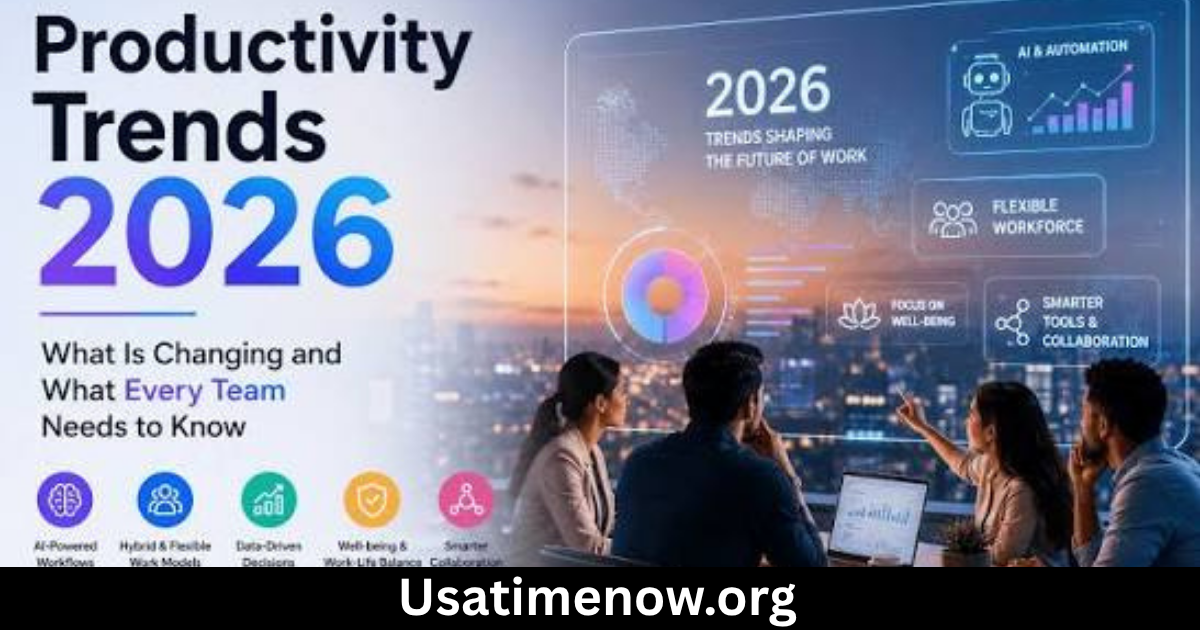
Productivity trends 2026 are being shaped by artificial intelligence, automation, flexible work, smarter workflows, and a growing focus on meaningful results rather than simply staying busy. Businesses and individuals are looking for better ways to save time, reduce repetitive tasks, improve concentration, and accomplish more without increasing workload.
AI is becoming particularly important. Current research shows that organizations are moving beyond simple AI experimentation toward integrating AI into everyday workflows, while companies are increasingly measuring productivity through outcomes and business value.
1. AI-Powered Productivity Becomes a Standard
One of the biggest productivity trends 2026 is the rapid adoption of AI tools. Employees are using AI for writing, research, analysis, coding, brainstorming, summarizing information, and handling repetitive administrative work.
Gallup reported in July 2026 that 52% of U.S. workers were using AI in their roles, with 30% using it frequently. Organizations are also increasingly integrating AI tools specifically to improve productivity, efficiency, and quality.
The important change is that AI is no longer viewed only as an experimental technology. It is increasingly becoming part of normal workflows. Instead of replacing every task performed by a person, AI can assist workers by reducing the amount of time required for routine activities.
2. AI Agents and Automated Workflows
AI agents are another major development in productivity trends 2026. Unlike traditional software that performs one predefined action, AI agents can work toward a goal, complete multiple steps, and interact with other systems under human supervision.
Google Cloud identifies agentic workflows as a major 2026 business trend, with companies connecting multiple AI agents to automate more complicated processes.
For example, an AI-powered workflow could collect information, organize it, prepare a report, identify important findings, and send the results to the appropriate person. This can reduce manual coordination and allow employees to spend more time on decision-making and creative work.
However, successful automation still requires human oversight. An AI system that creates additional errors or requires constant correction may reduce productivity rather than improve it.
3. Productivity Shifts From Hours to Outcomes
Another important productivity trend is the move away from measuring performance simply by hours worked. Spending more time at a desk does not necessarily mean producing better results.
Modern organizations are increasingly interested in outcomes such as completed projects, customer satisfaction, revenue, quality, innovation, and problem-solving. This approach can encourage employees to focus on valuable work rather than unnecessary activity.
PwC’s 2026 AI Jobs Barometer found that productivity growth is substantially higher at companies more exposed to AI, while skills requirements are also changing rapidly.
The result is a workplace where productivity increasingly means working smarter and producing meaningful results, not simply working longer.
4. Hybrid Work Continues to Evolve
Flexible and hybrid work remain important parts of productivity trends 2026. Instead of asking whether remote or office work is always better, organizations are increasingly experimenting with work arrangements that match the type of work being performed.
Research from Prodoscore reported that hybrid workers continued to show a productivity advantage in its 2026 data, productivity trends 2026 that flexibility combined with structure can support consistent performance.
The most effective approach can depend on the organization, employee, and job. Tasks requiring deep concentration may work well remotely, while brainstorming, training, relationship-building, and complex collaboration may benefit from in-person interaction.
5. Focus Time Is Becoming More Valuable
Modern workers face constant notifications, meetings, emails, messages, and digital interruptions. As a result, protecting uninterrupted focus time is becoming an important productivity strategy.
A 2026 workplace study from ActivTrak found that collaboration and multitasking had increased while focus time had fallen to a three-year low.
This creates a productivity paradox: employees can appear extremely busy while making less progress on important work.
Organizations are therefore experimenting with meeting-free periods, notification controls, asynchronous communication, and dedicated deep-work sessions. Individuals can also benefit from turning off unnecessary alerts and concentrating on one high-priority task at a time.
6. Automation Reduces Repetitive Tasks
Automation continues to influence productivity trends across almost every industry. Routine activities such as data entry, scheduling, document processing, reporting, email organization, and repetitive calculations can increasingly be automated.
Microsoft highlights connected workflows and AI automation as ways organizations can reduce the manual work required to move information between disconnected systems.
The goal is not automation for its own sake. Good automation removes friction from a workflow and gives employees more time for activities requiring judgment, creativity, communication, and expertise.
7. Human Skills Become More Important
One of the interesting productivity trends 2026 is that technological progress is increasing the importance of certain human capabilities.
Critical thinking, leadership, communication, creativity, decision-making, relationship-building, and professional judgment remain difficult to automate completely. productivity trends 2026 research found that AI-exposed jobs are changing particularly quickly and that some roles increasingly demand traditionally senior skills such as leadership and judgment.
This means productivity in 2026 is not simply about learning more software. Workers who can combine technology with strong human skills may have a significant advantage.
8. Personal Productivity Becomes More Intentional
Productivity is also changing at an individual level. People are increasingly focusing on energy management, prioritization, digital organization, and realistic workloads.
Instead of creating enormous daily task lists, productive workers can identify a few important priorities and protect time for them. Calendar blocking, task management applications, AI assistants, automated reminders, and structured routines can all support this approach.
The emphasis is shifting from doing everything to doing the right things consistently.
How Businesses Can Adapt to Productivity Trends 2026
Businesses that want to benefit from these trends should start with existing workflows rather than immediately purchasing more technology. Companies should identify repetitive processes, communication bottlenecks, unnecessary meetings, and tasks that consume significant employee time.
AI should then be introduced where it can produce measurable improvements. Organizations also need clear policies, training, security controls, and human oversight. Recent research from McKinsey emphasizes that simply increasing AI adoption does not automatically create lasting business value; organizations often need to redesign processes around the technology.
The best productivity strategy is therefore a combination of technology, good processes, skilled people, and clear goals.
FAQs About Productivity Trends 2026
What is the biggest productivity trend in 2026?
AI-powered productivity trends 2026 is one of the biggest trends. Businesses are increasingly using generative AI, automation, and AI agents to reduce repetitive work and support employees.
How is AI changing productivity?
AI can help with writing, research, analysis, coding, summarization, customer service, and workflow automation. productivity trends 2026greatest value often comes when it is integrated into existing processes rather than used as a standalone tool.
Is hybrid work still a productivity trend in 2026?
Yes. Hybrid work continues to evolve as organizations look for flexible arrangements that balance employee autonomy with collaboration and business needs.
Why is focus time important for productivity?
Constant meetings, notifications, and multitasking can make it difficult to complete complex work. Dedicated focus periods allow productivity trends 2026 to concentrate on important tasks without continuous interruptions.
Will AI replace productivity tools?
AI is more likely to transform productivity tools than completely replace them. Task managers, calendars, collaboration platforms, and business software are increasingly adding AI features to make their existing functions more useful.
What skills are important for productivity in 2026?
Critical thinking, communication, creativity, leadership, adaptability, problem-solving, and AI literacy are increasingly valuable. Workers who understand how to use AI effectively can combine technological efficiency with human judgment.
How can individuals improve productivity in 2026?
Start by identifying high-value tasks, reducing unnecessary distractions, automating repetitive activities, using AI where appropriate, productivity trends 2026 protecting uninterrupted focus time.
Conclusion
The biggest productivity trends 2026 point toward a workplace that is increasingly automated, flexible, AI-assisted, and outcome-focused. AI agents and automation can handle more routine activities, while employees increasingly concentrate on judgment, creativity, collaboration, and strategic decisions.
However, technology alone does not guarantee productivity. The strongest results come when organizations redesign inefficient workflows, give employees the right tools and training, and measure meaningful