






Table of Contents
A job interview evaluation form is an important recruitment tool that helps employers assess candidates fairly, consistently, and objectively. job interview evaluation form It provides a structured way to record interview responses, evaluate relevant skills, and compare applicants against the requirements of a position.
Without a clear evaluation process, hiring decisions may depend too heavily on personal impressions or individual preferences. A standardized interview evaluation form helps recruiters and hiring managers make informed decisions, improve hiring quality, and maintain accurate recruitment records.
What Is a Job Interview Evaluation Form?
A job interview evaluation form is a document used by recruiters and hiring managers to assess a candidate’s qualifications, experience, communication skills, and overall suitability for a job.
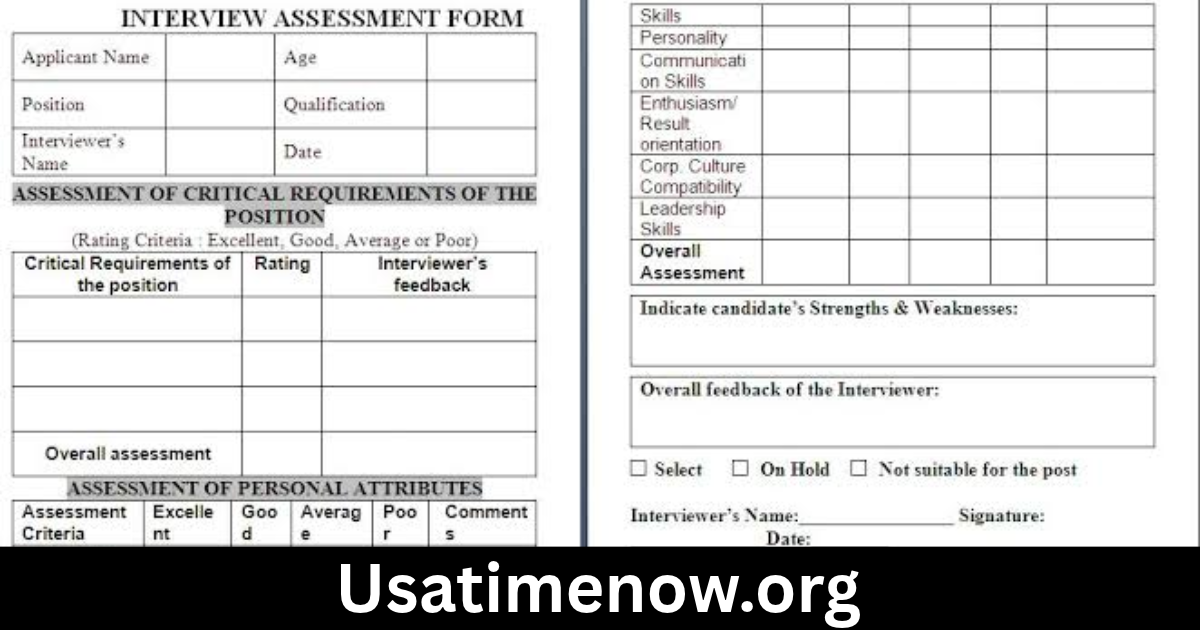
It typically includes candidate details, interview questions, evaluation criteria, scoring sections, interviewer comments, and a final recommendation.
Employers can use this form during phone interviews, virtual interviews, panel interviews, and in-person meetings.
Why Is a Job Interview Evaluation Form Important?
A structured interview evaluation form offers several benefits to organizations.
1. Promotes Fair Candidate Assessment
Using the same evaluation criteria for applicants applying for the same position helps reduce inconsistent judgments. It encourages interviewers to focus on job-related qualifications and demonstrated abilities.
2. Improves Hiring Decisions
A written record of candidate responses makes it easier to compare applicants and identify who best meets the position’s requirements.
3. Reduces Interviewer Bias
Personal impressions can influence hiring decisions. A standardized scoring system encourages interviewers to assess candidates based on evidence rather than assumptions.
4. Creates Consistent Recruitment Records
Evaluation forms provide documentation of interview performance, interviewer observations, and hiring recommendations. These records can support internal reviews and recruitment process improvements.
5. Saves Time for Hiring Teams
A well-designed form keeps interviews organized and makes it easier to review candidate performance without relying entirely on memory.
Key Sections of a Job Interview Evaluation Form
An effective interview evaluation form should include the following sections.
Candidate Information
Start with basic information to identify the applicant and the position.
Include:
- Candidate’s full name
- Job title
- Department
- Interview date
- Interviewer’s name
- Interview stage
Interview Evaluation Criteria
The main section should assess qualities that are relevant to the position.
| Evaluation criteria | What to assess |
|---|---|
| Relevant experience | Previous responsibilities and achievements |
| Technical skills | Knowledge and abilities required for the role |
| Communication | Clarity, listening, and explanation skills |
| Problem-solving | Ability to analyze situations and find solutions |
| Adaptability | Response to change and new challenges |
| Teamwork | Collaboration and professional relationships |
| Role knowledge | Understanding of the position and its responsibilities |
| Motivation | Interest in the role and career goals |
Not every criterion applies to every job. Employers should select categories based on the actual responsibilities of the position.
Interviewer Comments
Provide space for interviewers to record specific examples, strengths, concerns, and answers that demonstrate relevant competencies.
Comments should be factual and connected to the evaluation criteria.
Overall Recommendation
The form should conclude with a clear recommendation, such as:
- Strongly recommend
- Recommend
- Consider for another position
- Further assessment required
- Do not recommend
Interviewers should support their recommendation with evidence from the interview.
Sample Job Interview Evaluation Form
The following example can be adapted for different positions and industries.
Job Interview Evaluation Form
Candidate Details
- Candidate Name: __________________________
- Position Applied For: ______________________
- Department: ______________________________
- Interview Date: ___________________________
- Interviewer: ______________________________
Candidate Assessment
Use a rating scale from 1 to 5:
- 1 – Poor
- 2 – Below expectations
- 3 – Meets expectations
- 4 – Exceeds expectations
- 5 – Excellent
| Evaluation area | Score (1–5) | Comments |
|---|---|---|
| Relevant experience | _____ | __________________ |
| Technical knowledge | _____ | __________________ |
| Communication skills | _____ | __________________ |
| Problem-solving ability | _____ | __________________ |
| Teamwork and collaboration | _____ | __________________ |
| Adaptability | _____ | __________________ |
| Role-specific competencies | _____ | __________________ |
Overall Interview Feedback
Candidate’s key strengths: __________________________
Areas requiring further development: __________________
Additional assessment needed: _______________________
Final Recommendation
- Strongly recommend
- Recommend
- Further assessment required
- Do not recommend
Interviewer Signature: ______________________
Date: ______________________
This template is a starting point. Employers should customize the evaluation categories, scoring guidance, and recommendation options to match the role.
How to Use a Job Interview Evaluation Form
Using an evaluation form effectively requires preparation and consistency.
Step 1: Define the Job Requirements
Before interviews begin, identify the essential skills, qualifications, and competencies needed for the position.
These requirements should come directly from the job description and expected responsibilities.
Step 2: Prepare Standardized Interview Questions
Develop questions that assess the same core competencies for every candidate applying for the role.
For example, a teamwork question could be: “Describe a time you worked with others to solve a challenging problem.”
Behavioral questions help interviewers understand how candidates have handled real workplace situations.
Step 3: Explain the Rating Scale
Make sure every interviewer understands what each score represents. A score of 5 should have a clear meaning rather than simply indicating that an interviewer liked a candidate.
Where possible, provide examples of behaviors associated with each rating.
Step 4: Record Evidence During the Interview
Interviewers should take concise notes about the candidate’s responses, relevant examples, and demonstrated skills.
Avoid relying on memory or recording vague impressions such as “good personality.”
Step 5: Complete the Evaluation
After the interview, assign scores based on the agreed criteria and write supporting comments.
If multiple interviewers participate, they should complete their evaluations independently before discussing their overall impressions.
Step 6: Compare Candidates
Review completed forms to identify which applicants best meet the role’s essential requirements.
Consider the evidence behind each score rather than relying only on the total numerical result.
Step 7: Document the Final Decision
Record the hiring recommendation and relevant reasons for the decision. Store evaluation forms securely and retain them according to the organization’s recordkeeping policies and applicable laws.
Best Practices for Effective Interview Evaluation
Employers can improve their interview evaluation process by following these practices:
- Use job-related criteria: Evaluate skills and competencies that matter to the position.
- Ask consistent questions: Give candidates comparable opportunities to demonstrate their abilities.
- Use clear scoring guidelines: Define what each rating means before interviews begin.
- Take factual notes: Record specific examples rather than personal assumptions.
- Train interviewers: Help hiring teams recognize bias and apply evaluation standards consistently.
- Allow reasonable accommodations: Make the interview process accessible to candidates who need adjustments.
- Protect candidate information: Limit access to evaluation records and follow applicable privacy requirements.
- Review hiring outcomes: Check whether evaluation criteria help predict successful job performance.
Common Mistakes to Avoid When Evaluating Candidates
Even well-designed forms can produce poor results if interviewers use them incorrectly.
Relying on First Impressions
A candidate’s appearance, confidence, or interview style does not necessarily reflect their ability to perform the job. Focus on relevant evidence and competencies.
Using Vague Evaluation Criteria
Terms such as “good fit” or “strong personality” can lead to subjective decisions. Replace them with specific, measurable, job-related behaviors.
Giving Every Candidate Similar Scores
Interviewers should distinguish between different levels of demonstrated performance. Ratings should reflect actual answers and examples.
Ignoring Negative or Positive Evidence
Evaluation should consider the full interview rather than focusing only on one strong or weak response.
Failing to Complete Forms Promptly
Waiting too long to document feedback can result in forgotten details and less accurate evaluations.
How Technology Can Improve Interview Evaluation
Digital recruitment tools can make interview evaluation easier to manage.
Applicant tracking systems can store interview feedback, organize candidate records, and help recruiters monitor recruitment progress. Online forms also allow interviewers to submit evaluations from different locations.
Some organizations use automated tools to summarize feedback or organize assessment information. However, technology should support—not replace—human judgment. Employers should review automated outputs for accuracy, fairness, and compliance with relevant employment and privacy laws.
FAQs About Job Interview Evaluation Forms
1. What is the purpose of a job interview evaluation form?
Its purpose is to help interviewers assess candidates consistently by recording their qualifications, skills, responses, and overall suitability for a position.
2. What should an interview evaluation form include?
It should include candidate details, evaluation criteria, a rating scale, interviewer comments, an overall assessment, and a final recommendation.
3. What is a good rating scale for interview evaluations?
A five-point scale is commonly used, ranging from 1 (poor) to 5 (excellent). Employers should define each rating clearly to encourage consistent scoring.
4. Who should complete the interview evaluation form?
Recruiters, HR professionals, hiring managers, and panel interviewers may complete evaluation forms, depending on their roles in the recruitment process.
5. Should every candidate receive the same interview questions?
Candidates applying for the same position should generally receive the same core questions and be assessed against consistent criteria. Relevant follow-up questions may be used to clarify responses.
6. Can an interview evaluation form be used for virtual interviews?
Yes. The same evaluation principles apply to video and phone interviews. Digital forms can make recording and sharing feedback easier.
7. How long should employers keep interview evaluation forms?
Retention periods depend on applicable employment, privacy, and recordkeeping laws, as well as organizational policies. Employers should store records securely and retain them only as required.
Conclusion
A job interview evaluation form helps organizations make more consistent, evidence-based recruitment decisions. job interview evaluation form By using clear criteria, standardized questions, defined scoring guidelines, and factual interviewer comments, employers can compare candidates more effectively. The best interview evaluation forms are simple, relevant, and tailored to the position. When combined with trained interviewers and a fair recruitment process, they help businesses identify qualified candidates, improve hiring quality, and create a more professional candidate experience.