






Table of Contents
An overtime pay calculator is a useful tool for employees, employers, and payroll professionals who need to determine wages for hours worked beyond a standard work schedule. overtime pay calculator It helps estimate additional earnings by using an employee’s regular hourly rate, overtime hours, and applicable overtime multiplier.
Understanding how overtime pay works is important for managing payroll, tracking working hours, and ensuring employees receive the compensation they are entitled to. Whether you work hourly or manage a team, learning how to calculate overtime can make wage calculations easier and more accurate.
What Is an Overtime Pay Calculator?
An overtime pay calculator is a tool that estimates how much an employee should earn for working beyond their regular scheduled hours. It typically uses three main details:
- Regular hourly pay rate
- Number of overtime hours worked
- Overtime pay multiplier, such as 1.5 or 2 times the regular rate
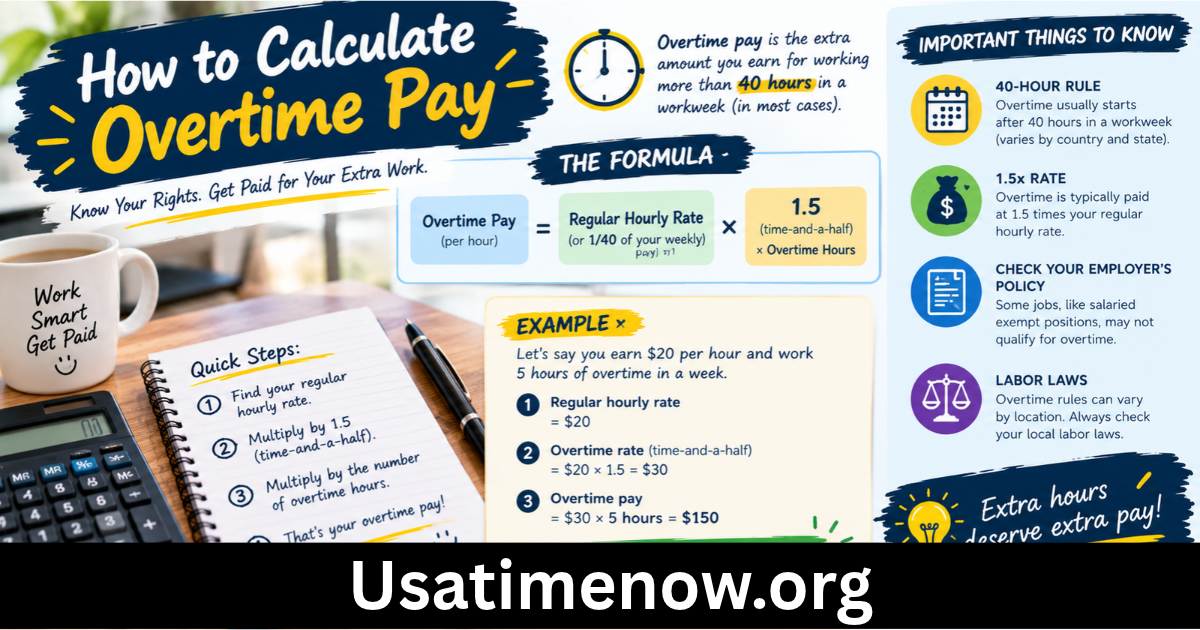
For example, if an employee earns $20 per hour and receives time-and-a-half overtime pay, the overtime rate is $30 per hour.
If the employee works five overtime hours, the additional overtime earnings would be:
$20 × 1.5 × 5 = $150
The calculator can help estimate these earnings without requiring manual calculations.
How to Calculate Overtime Pay
Calculating overtime pay involves identifying the regular hourly wage, determining the number of eligible overtime hours, and applying the correct overtime rate.
Step 1: Determine the Regular Hourly Rate
Start by identifying the employee’s regular hourly wage. If an employee earns an annual salary, the hourly equivalent may need to be calculated using the applicable work schedule and payroll rules.
For example, an employee earning $48,000 annually and working 40 hours per week has an estimated hourly equivalent of:
$48,000 ÷ 52 weeks ÷ 40 hours = $23.08 per hour.
This is a simplified example. Actual overtime calculations for salaried employees may require additional information about compensation and applicable laws.
Step 2: Identify Overtime Hours
Determine how many hours qualify as overtime under the applicable employment rules or company policy.
For example, if an employee works 47 hours in a workweek and the overtime threshold is 40 hours, the employee has seven overtime hours.
Not every country or employment arrangement uses the same overtime threshold. Some rules also consider daily working hours, rest days, or special shifts.
Step 3: Apply the Overtime Multiplier
Multiply the regular hourly rate by the applicable overtime multiplier.
Common examples include:
- 1.5 times: Often called time-and-a-half.
- 2 times: Commonly called double time.
- 1 times: Regular hourly pay, where no additional overtime premium applies.
The correct multiplier depends on applicable law, employment agreements, and workplace policies.
Step 4: Calculate Total Overtime Earnings
Multiply the overtime hourly rate by the number of overtime hours.
For example:
- Regular hourly rate: $20
- Overtime multiplier: 1.5
- Overtime hours: 8
- Overtime hourly rate: $30
Total overtime earnings:
$30 × 8 = $240
This amount represents overtime earnings before applicable deductions.
Overtime Pay Calculation Formula
The basic overtime pay formula is:
Overtime Pay = Regular Hourly Rate × Overtime Multiplier × Overtime Hours
To calculate total gross wages, add regular earnings and overtime earnings.
Total Gross Pay = Regular Earnings + Overtime Earnings
For example, an employee works 40 regular hours and eight overtime hours at a regular rate of $18 per hour. Assuming a 1.5 overtime multiplier:
| Pay component | Calculation | Amount |
|---|---|---|
| Regular pay | 40 × $18 | $720 |
| Overtime rate | $18 × 1.5 | $27 |
| Overtime pay | 8 × $27 | $216 |
| Total gross pay | $720 + $216 | $936 |
The total gross pay is $936 before taxes and other deductions.
Example of an Overtime Pay Calculator
Consider an employee who earns $25 per hour and works 10 overtime hours during a pay period. The employer applies a 1.5 overtime multiplier.
The calculation is:
- Regular hourly rate: $25
- Overtime multiplier: 1.5
- Overtime hourly rate: $25 × 1.5 = $37.50
- Overtime hours: 10
- Total overtime earnings: $37.50 × 10 = $375
The employee earns an additional $375 in overtime wages, assuming all 10 hours qualify and the stated rate applies.
Different Types of Overtime Pay
Overtime compensation can vary depending on employment laws, industry requirements, and company agreements.
Time-and-a-Half
Time-and-a-half means employees receive 150% of their regular hourly rate for eligible overtime hours.
For example, someone earning $16 per hour would receive:
$16 × 1.5 = $24 per overtime hour.
Double-Time Pay
Double-time pay means employees receive twice their regular hourly wage for qualifying hours.
For an employee earning $20 per hour:
$20 × 2 = $40 per overtime hour.
Double time may apply under certain agreements or specific working conditions, depending on the applicable rules.
Holiday and Weekend Overtime
Some employers provide additional compensation for work performed on public holidays, weekends, or designated rest days. However, these arrangements vary significantly.
Employees should check their employment contracts, workplace policies, and local labor regulations to understand which premium rates apply.
Overtime Pay for Salaried Employees
Salaried employees receive a fixed amount of compensation rather than an hourly wage. However, being paid a salary does not automatically mean an employee is ineligible for overtime.
Eligibility depends on the employee’s duties, classification, salary structure, and the employment laws that apply.
To estimate overtime for a salaried employee, payroll professionals may need to determine the appropriate regular rate before applying the relevant overtime formula.
Employers should avoid assuming that every salaried worker is exempt from overtime requirements.
Overtime Pay Calculator for Different Work Schedules
Different work schedules can affect how overtime is recorded and calculated.
Weekly Overtime
Weekly overtime calculations are based on eligible hours worked during a defined workweek. For example, if the applicable threshold is 40 hours and an employee works 46 eligible hours, six hours may qualify as overtime.
Daily Overtime
Some jurisdictions require overtime compensation when employees work more than a specified number of hours in a single day.
For example, a worker may qualify for overtime after exceeding a daily limit, even if the total weekly hours remain below a weekly threshold.
Shift-Based Overtime
Employees working rotating shifts, overnight schedules, or extended shifts may have additional payroll considerations. Employers should apply the relevant rules when calculating eligible hours and compensation.
Common Overtime Pay Calculation Mistakes
Incorrect overtime calculations can lead to payroll disputes, employee dissatisfaction, and potential compliance problems.
Common mistakes include:
- Using the wrong hourly rate: Always verify the employee’s applicable regular rate.
- Miscounting overtime hours: Maintain accurate attendance and timekeeping records.
- Applying an incorrect multiplier: Confirm the rate required by law or the employment agreement.
- Ignoring eligible compensation: Some overtime systems require certain additional earnings to be included when determining the regular rate.
- Confusing gross and net pay: Overtime calculations generally determine gross wages before deductions.
- Assuming salaried employees are automatically exempt: Check the employee’s actual legal classification.
Reviewing payroll information regularly can help prevent these problems.
Tips for Using an Overtime Pay Calculator Effectively
An overtime calculator is most useful when the information entered is accurate.
- Check your hourly rate: Confirm your regular pay rate before calculating overtime.
- Track working hours: Use reliable timesheets or attendance records.
- Choose the correct multiplier: Do not automatically assume that every workplace uses 1.5 times the regular rate.
- Understand your workweek: Overtime may be calculated according to a specific workweek or another legally defined period.
- Review your pay statement: Compare calculated earnings with the overtime amount shown on your payslip.
- Consider applicable deductions: Remember that take-home pay will usually be lower than gross earnings.
FAQs About Overtime Pay Calculators
1. How do I calculate overtime pay?
Multiply the regular hourly rate by the applicable overtime multiplier, then multiply that result by the number of overtime hours. For example, $20 × 1.5 × 5 hours equals $150.
2. What does time-and-a-half mean?
Time-and-a-half means an employee receives 1.5 times their regular hourly wage for eligible overtime hours. An employee earning $20 per hour would receive $30 per overtime hour.
3. Is overtime pay calculated before or after taxes?
Overtime pay is generally calculated as gross earnings before taxes and other payroll deductions. The employee’s final take-home amount depends on applicable deductions.
4. Can salaried employees receive overtime pay?
Yes, some salaried employees qualify for overtime. Eligibility depends on applicable employment laws, job duties, salary arrangements, and employee classification.
5. Does an overtime calculator include holiday pay?
A basic overtime calculator may not include special holiday rates. Users may need to enter the appropriate multiplier or calculate holiday compensation separately.
6. How many overtime hours are considered normal?
There is no universal number of normal overtime hours. Limits, thresholds, and compensation requirements vary by jurisdiction, industry, and employment agreement.
7. Why is my overtime pay different from my calculation?
Differences may result from the regular rate used, overtime eligibility, additional compensation, payroll adjustments, rounding, or deductions. Review your time records and payslip to identify the reason.
Conclusion
An overtime pay calculator makes it easier to estimate additional earnings for hours worked beyond a regular schedule. overtime pay calculator By understanding the regular hourly rate, overtime hours, and applicable multiplier, employees and employers can calculate overtime wages more confidently. Accurate overtime calculations also depend on reliable timekeeping, correct employee classification, and compliance with applicable labor regulations. Using a calculator alongside clear payroll policies can help organizations manage compensation effectively and ensure employees understand how their overtime earnings are determined.